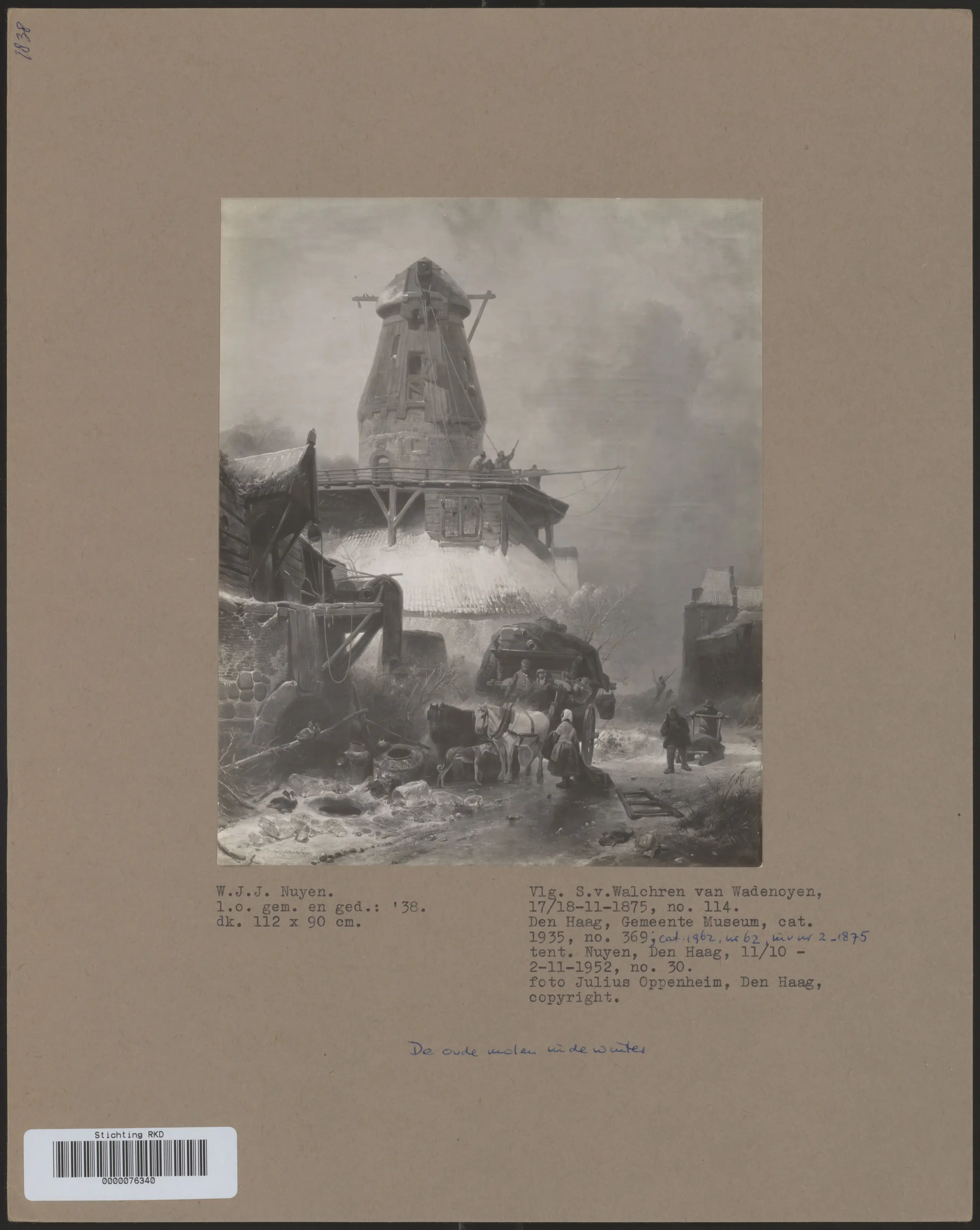
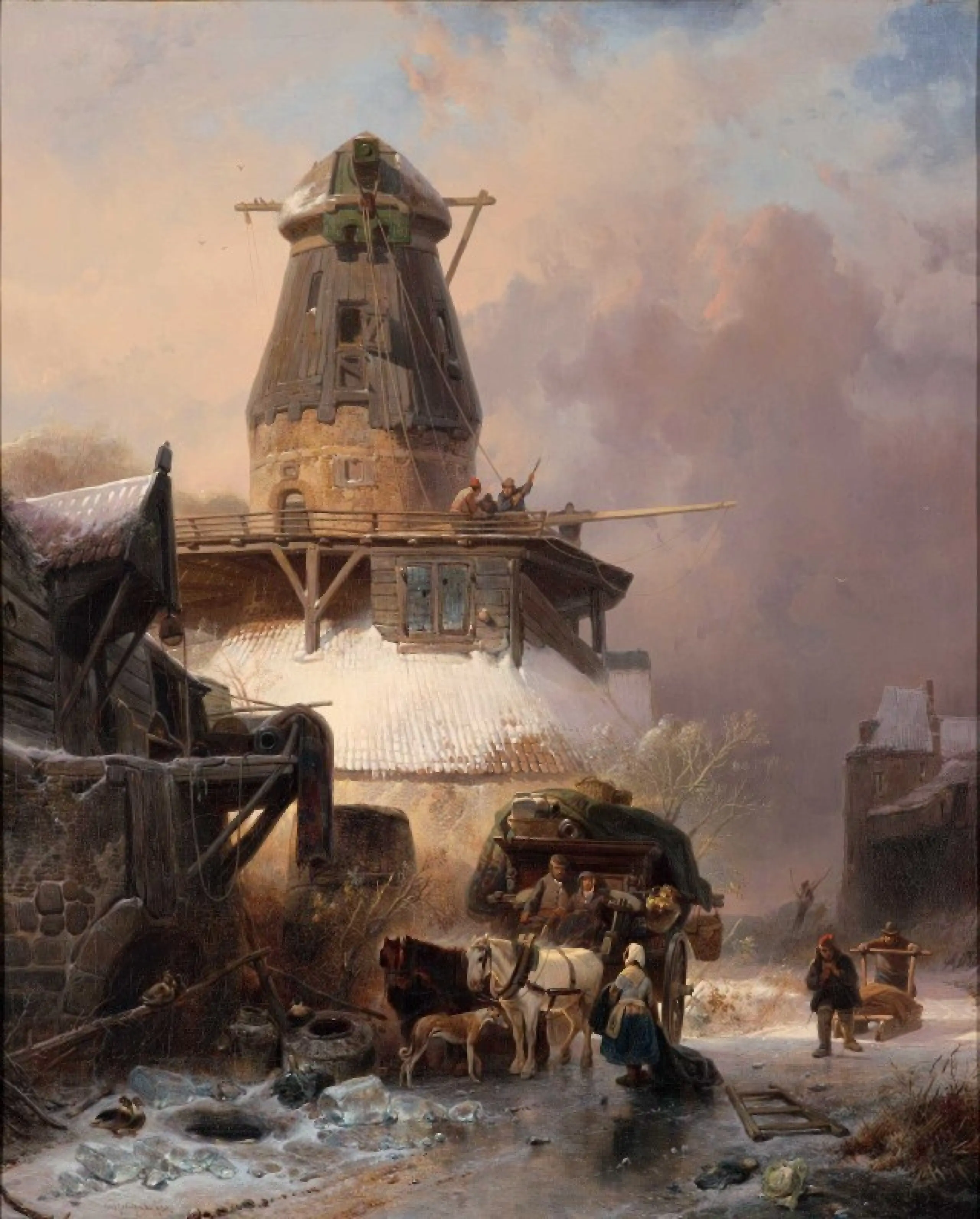
The old mill in winter
The move in the winter
- Artist
- Wijnandus Johannes Josephus Nuijen (1813-1839)
- Year
- 1838
- Genre
- landscape winter
- Keywords
- mill, winter
- Category
- painting
- Support
- canvas
- Technique
- oil
- Composition
- vertical
- Measurements
- 112.5 x 91.5 cm
- Signed
- unknown, W.J.J. Nuyen BZ f 1838
- Location
- Museum depot
- Owner
- Artmuseum The Hague formerly Gemeentemuseum The Hague, Object 0331265
Description
This work was purchased by King William II immediately after its completion. Despite the fact that this painting by Nuijen is one of his last works, it strongly shows the influence of his father-in-law, Schelfhout. The small chunks of ice on the left in the foreground could even be called Schelfhout's trademark.
Nevertheless, the painting possesses some typical Nuijen features. As in many of his works, the light plays between the building in the foreground and the windmill in the background, thereby enhancing the sense of depth.
Source: 1993 catalogue Wijnand Nuijen and his friends
Nuyen's talent remains undeniable even now, but it is more difficult to determine in what respect his work was perceived as an innovation. It was likely his pronounced colors and sharp contrasts that placed him outside the traditional, while his themes drew upon the intellectual world of Romanticism. The painting depicted here in color is a typical example of this.
We see a dilapidated mill in a winter landscape. A carriage, drawn by three horses, halts on the ice. A man and a woman sit on the box; a farmer's wife with a blanket stands beside the carriage. Two men are dragging a sled across the ice. Behind them, a tall country house lies in the twilight.
In this painting, too, Nuyen did not shy away from the contrast between light and dark areas. The contours of the building on the left in the foreground stand out darkly against the brightly lit roof of the mill, which gleams white with frozen snow. The steaming white horse stands out against the two brown horses, which are no longer illuminated by the sun.
The bare branches of the tree and the men with the sleigh, set against the dark sky and the somber house, are also part of this carefully considered arrangement of light and dark. The dark and light groups are filled with a wealth of details, which, however, do not detract from the overall composition. The shape of the country house in the background is reminiscent of the buildings Nuyen painted in his Norman landscapes. Despite the windmill and the ice, the atmosphere of this painting lacks that unmistakably Dutch quality found in the winter scenes of his teacher Schelfhout, which are clearly a continuation of the famous landscape art of the Dutch seventeenth century.
In Nuyen's work, it is not a compilation of anecdotal scenes of ice entertainment, but rather appears to be an episode from a romantic winter tale of a harsh journey. His work aligns with the turbulent Romantic art he had come to know during a visit to France and Paris.
Source: OKB April/June 1974
Exhibitions
Sources
- 1920 book ‘Dutch art in the 19th century’ G.H. Marinus, image 38
- 1935 book 'Le Romantisme' Paul Colin , image 140
- 1938 book ‘Dutch art from van Eyck till van Gogh’ dr. G. Knuttel, image page 417
- 1940 book 'era of camera obscura' , page 74 image 47
- 1946 book ‘one hundred years of Dutch paintings and drawings' P.A. Scheen , image 237
- 1947 book ‘from romance to realism’ J. Knoef , page 61/65/73 image page 54
- 1952 catalog exhibition ‘paintings and drawings by W.J.J. Nuijen' Panorama Mesdag The Hague, nummer 30 afbeelding bladzijde 39
- 1962 catalog Artmuseum The Hague, number 62
- 1977/1978 catalog 'Wijnand Nuyen 1813-1839 romantic works' exhibition The Hague 1977 (John Sillevis / Nini Jonker) , page 74
- 1986 book 'In Search of the Golden Age - Dutch Paintings 1800-1850', page 133 nr 43 description and page 135 image
- 1993 Catalog tentoonstelling Rijswijk ‘The friends of Wijnand Nuijen’ Henk Dinkelaar, image 2.16 page 34
- 2005 book ‘Masters of romantic art – Dutch artists 1800-1850’ Ronald de Leeuw / Jenny Reynaerts / Benno Tempel, image pagina 72
- 2006 book 'the Book of Romantic Art' Ronald de Leeuw / Benno Tempel, page 221
- 2014 book 'Willem II the king and art' Dordrechts Museum , catalog 166, page 266, image page 267
Provenance
- 1838 purchased by King William II immediately after completion
- 1850 auction King William II sold to D. van de Wijnperse The Hague price dfl 2050,-
- 1875 auction The Hague S. van Walcheren van Wadenoyen 17 en 18/11/1875. lot 114. Solt to ‘de Vereeniging’
- 1977 The art museum the Hague (in possession at the 1977/1978 exhibition) donation by the Friends of Kunstmuseum Den Haag (Vereeniging 1875).
Media