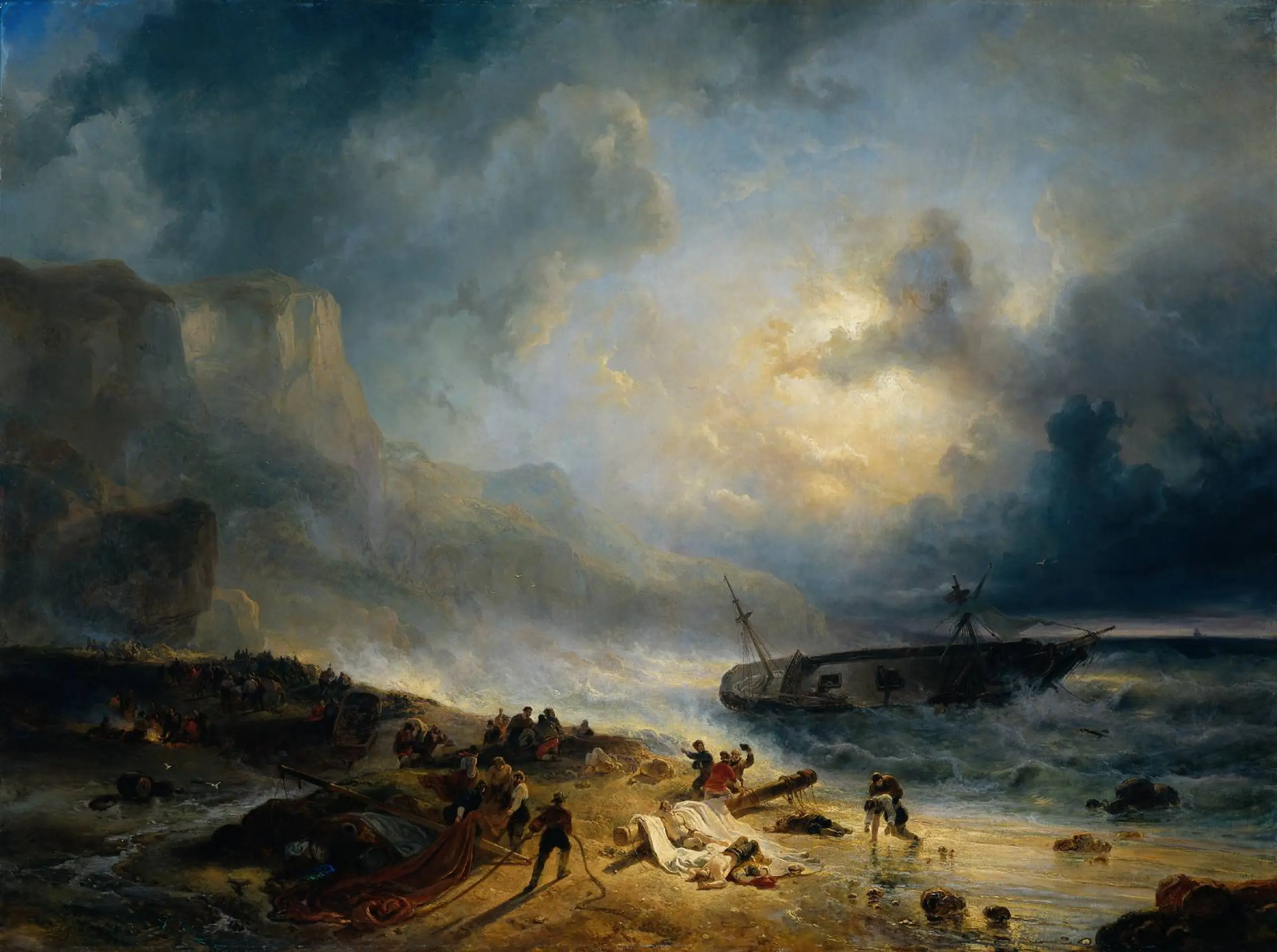
Shipwreck on a rocky coast
- Artist
- Wijnandus Johannes Josephus Nuijen (1813-1839)
- Year
- 1837
- Genre
- seascape
- Keywords
- coast, sea, ship, storm
- Category
- painting
- Support
- panel
- Technique
- oil
- Composition
- horizontal
- Measurements
- 153.5 x 205.5 cm
- Signed
- bottom left, W.J.J. Nuyen Bz f
- Location
- Museum permanent exhibition
- Owner
- Rijksmuseum Amsterdam, inv nr A 4645 catalogus nummer 1769 A2
Description
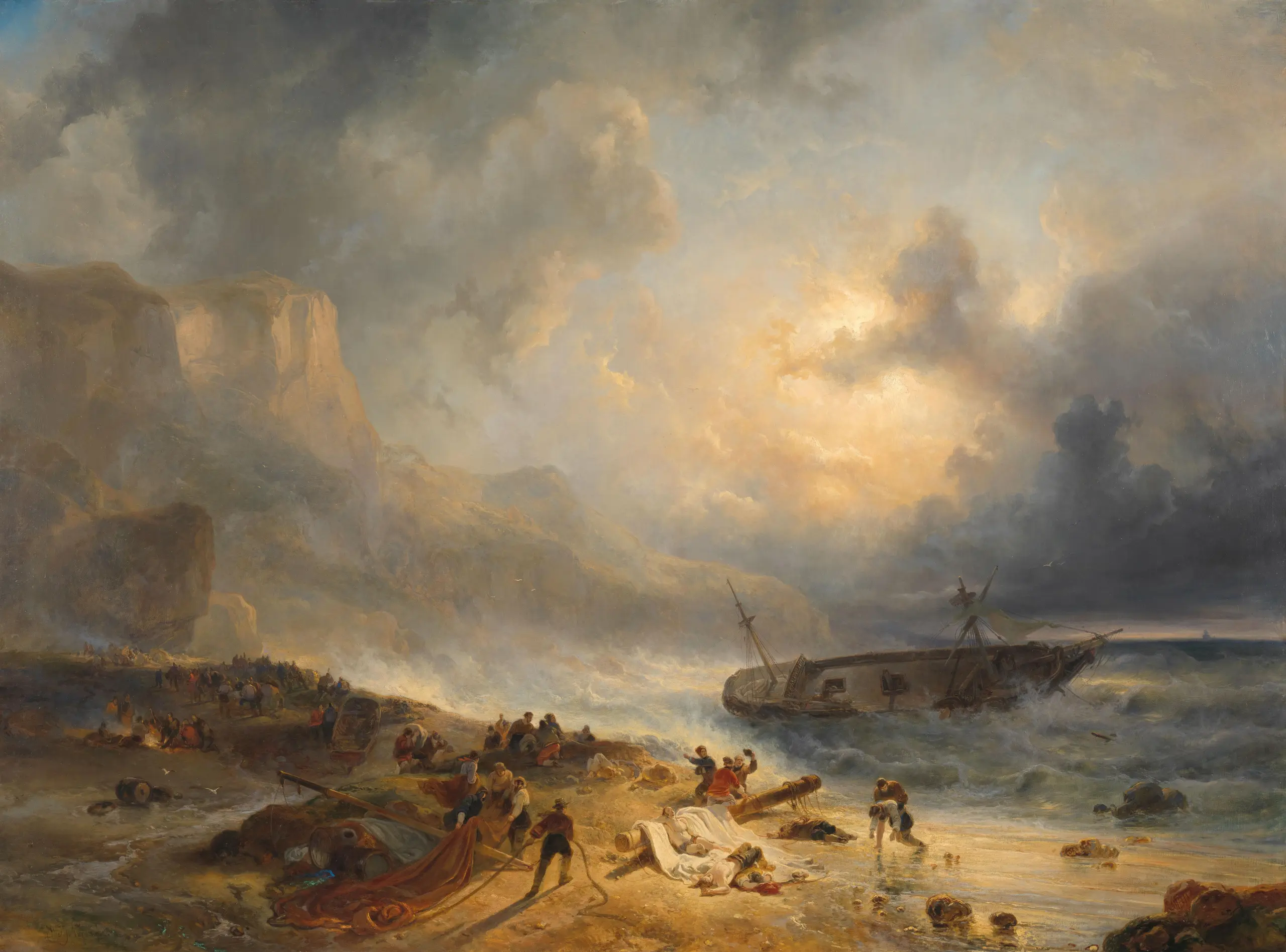
This painting is a highlight of Dutch Romanticism. It depicts the insignificance of man amidst nature. During a storm, a three-masted ship ran aground on the cliffs and sank. The crew desperately searches the beach for survivors. Sunbeams attempt to break through the dark sky, offering a view of the overwhelming, steep rock faces, making the people appear even smaller.
Source: 1986 In Search of the Golden Age – Dutch Paintings 1800-1850
Shortly after Nuyen's funeral in 1839, an extensive report of this sorrowful ceremony appeared in the Hague art magazine De Beeldende Kunsten. In this commemorative article, Nuyen's genius was praised with extraordinary homage; as proof of his rich imagination, attention was drawn to a ‘very magnificent’ painting depicting the wreckage of a three-masted ship on a rocky beach, with sunlight breaking through, which, according to the magazine, 'may be called outstanding, and all the more so when one considers it a product of the imagination, which could not even be supported by memory.' The painting, dated to around 1836, was then located in the cabinet of one of the greatest collectors of contemporary art in the Netherlands, the Hague Colonel De Ceva. It was subsequently purchased by King William II in 1843 and included in his famous collection. For a man of about 23, the ambitious Shipwreck on a Rocky Coast is a particularly remarkable achievement, all the more so because Nuyen succeeded admirably in turning the raging force of the elements into a grand and compelling drama. The violence of the storm, the turbulent sea, and especially the somewhat false effect of the unexpectedly breaking sunlight are depicted with precision and glowing colors. Only the foreground is perhaps a bit too gaudy, and for the careful observer, it is probably still understandable today why the style of Nuyen and his contemporaries was rejected by conservative critics as a 'phantasmagoria of colors'.
A comparison with the more traditional, but equally magnificent, Marine by Johannes Schotel from 1827 (cat. no. 61) immediately reveals how new and different Nuyen's use of color and painting style were. Schotel's much more graphic manner is still entirely based on the example of the Dutch Masters of the Golden Age, whereas contemporary French painters such as Gudin and Isabey are responsible for Nuyen's style. Nevertheless, Nuyen always remained moderate and cautious compared to his French examples: the Hague master never painted gigantic canvases with ghostly tidal waves in high-contrast colors.
Exhibitions
Sources
- 1947 book ‘from romance to realism’ J. Knoef
- 1967 catalog ‘fantasy and reality’ Dordrechts museum , nummer 120 afbeelding pagina 71
- 1970 book lexicon ‘Dutch visual artists 1750 -1950’ part II P. Scheen , afbeelding 233
- 1975 Bulletin of the Rijksmuseum , 23e jaargang No 2 pagina 73 en 75 C.J. de Bruyn Kops
- 1976 book 'All the paintings of the Rijksmuseum’ , pagina 421
- 1977/1978 catalog 'Wijnand Nuyen 1813-1839 romantic works' exhibition The Hague 1977 (John Sillevis / Nini Jonker) , nummer 48 pagina 82
- 1986 book 'In Search of the Golden Age - Dutch Paintings 1800-1850', page 132 number 42 description and image
- 1993 Catalog tentoonstelling Rijswijk ‘The friends of Wijnand Nuijen’ Henk Dinkelaar, bladzijde 49 afbeelding 4.01
- 1995 workpiece 'paintings in the 19th century' Harry Rijpkema
- 2000 book 'Poetry of reality – Dutch painters of the 19th century' Marjan van Heteren / Ronald de Leeuw , pagina 72 afbeelding 37
- 2001 Book 'Fruits from van Minerva, award-winning romantic works 1824-1851' by J. van Roekel, page 57 image 38
- 2005 book ‘Masters of romantic art – Dutch artists 1800-1850’ Ronald de Leeuw / Jenny Reynaerts / Benno Tempel, afbeelding pagina 235
- 2006 book 'the Book of Romantic Art' Ronald de Leeuw / Benno Tempel, pagina 276
- 2009 book 'Dutch art in the Rijksmuseum 1800-1900' Gijs van der Ham, Pagina 124 met kleuren illustratie
- 2012 book A.P.P.C.R.E. de Ceva, courtier in the artworld, Hugo Rijpma, page 137 colorpicture and description, pagina 137 kleurenfoto en beschrijving
- 2014 book 'Willem II the king and art' Dordrechts Museum , pagina 111 kleurenfoto
- 2017 book 'romantic art of the north', pagina 43, pagina 167
Provenance
- 1839 collection Colonel de Ceva The Hague
- 1843 Art gallery P.K. Koning Rotterdam
- 1843-1850 collection King William II purchased for dfl 3800,-
- 1850 aution collection King William II The Hague
- 1850 bought by A. Lamme, Rotterdam price dfl 1110,-
- Collection D.R. Dooyes ‘s Gravenland
- 1974 Auction Mak van Waay Amsterdam lot 50 dfl 80.000
- 1974 Collection Rijksmuseum Amsterdam
Links
Media